

Neals Live Edge Woodworking & Design


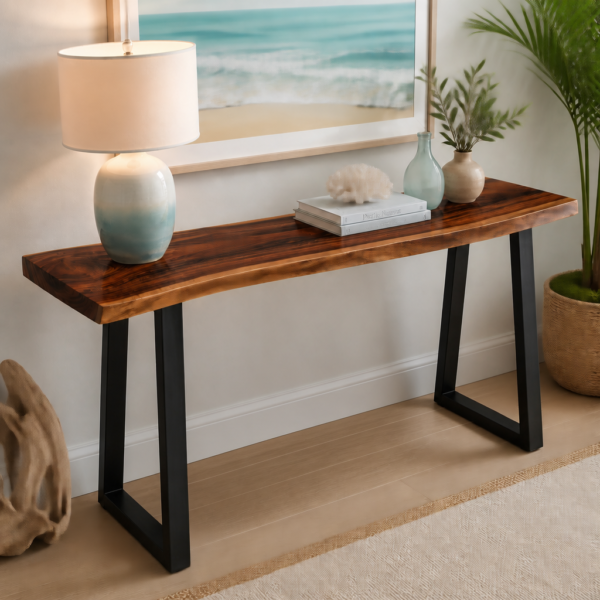
Patagonian Rosewood Live Edge Console Table
$1,100.00

Overview

This stunning live edge console table is handcrafted from a single slab of Patagonian Rosewood — a dense, richly grained hardwood prized for its deep amber and burgundy tones. The natural live edge is preserved along both sides of the slab, showcasing the raw beauty of the tree’s original form. Paired with matte-black Warmaxx trapezoid legs, this table strikes the perfect balance between organic elegance and modern industrial design.

Each piece is finished by hand in our Thalmann, Georgia workshop, using a penetrating oil finish that enhances the wood’s natural luster while providing lasting protection. No two slabs are alike — the grain pattern, color variation, and edge contour of your table are entirely unique to your piece.

Features


  • Wood Species: Patagonian Rosewood — dense, close-grained, with rich amber-to-burgundy color depth
  • Live Edge: Natural, unaltered slab edges preserved on both sides
  • Legs: Warmaxx Trapezoid — matte-black powder-coated steel, modern geometric profile
  • Finish: Hand-applied penetrating oil — enhances grain, resists moisture
  • Construction: Single solid slab — no veneers, no fillers
  • Hardware: Heavy-duty bolt-on mounting hardware included
  • Customization: Custom sizing and leg finish options available upon request

Dimensions


Spec Detail
Overall Length [Custom — contact for quote]
Overall Width [Custom — contact for quote]
Slab Thickness Approximately 1.75–2 inches
Leg Height 30 inches (standard console table height)
Weight [Varies by slab]
Leg Finish Matte Black Powder Coat


Care & Maintenance


Wipe with a soft, dry or lightly damp cloth for daily cleaning. Blot spills immediately — never allow moisture to pool on the surface. Re-oil with food-safe mineral oil every 3–6 months to maintain the finish and deepen the grain. Avoid prolonged direct sunlight and heat sources. Always use coasters and trivets. A complete Care & Maintenance Guide is included with every table.


Pro Tip: Wiping in the direction of the grain with a food-safe mineral oil once a season will keep your Patagonian Rosewood looking rich, vibrant, and protected for decades to come.


About Neal’s Live Edge Woodworking & Design


Neal’s Live Edge Woodworking & Design is a one-man studio in Thalmann, Georgia, dedicated to transforming naturally fallen and sustainably sourced hardwood slabs into heirloom-quality furniture. Every piece is designed, shaped, finished, and signed by Neal himself. When you purchase a live edge table from us, you’re not buying furniture off a shelf — you’re commissioning a piece of art that will outlast the trends.

Order & Inquiries


To place a custom order or ask about availability, sizing, or lead times, reach out directly:

  • Email: nealswoodworking@gmail.com
  • Location: Thalmann, Georgia

Each table is built to order. Current lead time is typically 4–8 weeks depending on slab availability and finishing schedule.


Neal’s Live Edge Woodworking & Design· Thalmann, GA·  Handcrafted from the heart of the forest.

Oh hi there 👋
It’s nice to meet you.

Sign up to to the first to receive awesome reviews, comparisons, and alerts to new products listed—sent to you. Join the list for helpful posts, insights, and everyday tips

We don’t spam! Read our privacy policy for more info.

10 Comments on Neals Live Edge Woodworking & Design

  1. avatar
    Marita says:

    It’s a very nice and beautiful console table, simple but looks so formal.

    A must have at the entrance or the entry way to the main living area.

    How do you maintain its very nice finish? I actually read, it needs re-oiling with mineral oil every 3-6 months and that makes sense to maintain its beauty.

    I wish I can buy one like it.

    Marita

    1. avatar
      admin says:

      Thank you so much — I really appreciate that! I’m glad you like the console table. It’s one of those pieces that’s simple by design but meant to feel refined and timeless, especially in an entryway.

      You’re absolutely right about maintenance — a light re‑oil every few months helps keep the finish looking rich and protects the wood. I usually recommend using a food‑safe mineral oil or a hardwax oil blend, depending on the species. The key is to wipe off any excess and let it cure properly so the surface stays smooth and natural.

      I work with both domestic and exotic hardwoods, so each piece reacts a little differently, but regular care really does preserve the depth and character of the grain.

      Thanks again for the kind words — it means a lot to see people connect with the craftsmanship behind the work.

      I will sometimes depending on the wood and the finish I use, send a small gift size can of wax that can be used on certain finishes if I used a wax finish. I am usually sending these with cutting boards and charcuterie boards, however, I may start including this in some tables as well.

  2. avatar
    Aly says:

    Neal, that Patagonian Rosewood console table hits a nice sweet spot between raw natural character and clean modern design. The single-slab build, preserved live edge, and matte-black trapezoid legs give it that custom heirloom vibe without losing everyday practicality.

    I also like that you included the maintenance guidance and the note about each slab being unique, because that helps set buyer expectations in a grounded way. Since you’re building to order, it may help conversions even more to add one concrete example size with a finished photo so shoppers can picture the table in an entryway or behind a sofa.

    1. avatar
      admin says:

      I am in the process of obtaining a slab of Patagonian Rosewood to make a Console Table. The table I plan to make is a 1 1/4″ thick x 15 3/4″ wide x 46 long. Once I receive the wood, I hope to have a video of the build and post it as well. 

  3. avatar
    Bryce says:

    Hi there,

    I really enjoyed looking through your work. Live-edge furniture has a unique character because every piece tells its own story through the grain, knots, and natural edges. I think that’s what makes handcrafted woodworking so appealing compared to mass-produced furniture.

    While I don’t build furniture myself, I have a real appreciation for the skill and patience that goes into creating pieces that preserve the beauty of the wood instead of hiding it.

    Have you found that customers usually come to you with a specific vision, or do many of them let the individual slab inspire the final design? It seems like each piece would naturally suggest something different.

    Thanks for sharing your craftsmanship. It’s always refreshing to see artisans creating furniture that’s both functional and genuinely one of a kind.

    1. avatar
      admin says:

      Thank you so much — I really appreciate you taking the time to share that. Live‑edge work has a way of pulling people in because the wood already has its own personality before I ever touch it, and it’s always great to hear when someone connects with that.

      As for how customers approach a piece, it’s honestly a mix. Some come in with a clear vision — dimensions, style, the type of wood they love — and I help them bring that idea to life. Others prefer to let the slab lead the way. Every board has its own grain movement, color shifts, and natural edge, and sometimes the wood suggests a design that wouldn’t have been obvious on paper. Those builds are especially fun because the final piece feels like a collaboration between the customer, the material, and the craft.

      I like to try to ensure the customer is always pleased with my work. I strive to give the customer what they want, some customers are dead set on this is what I want and there is nothing else will do; others are really not sure they just know they want something that looks a certain way or has a special grain pattern, etc. I always try to let them see the wood and feel it if possible and together we can come up with a design that gives them their perfect piece. That is why I build each one individual. I rarely just build one then try to sell.

      I’m glad the one‑of‑a‑kind aspect resonates with you. That’s exactly why I do this — functional furniture that still carries the story of the tree it came from.

  4. avatar
    Shafna says:

    Hi,

    This console table is absolutely gorgeous, and I really like how the design balances the natural character of the Patagonian Rosewood with the clean, modern look of the trapezoid legs. The care instructions were helpful.  It’s nice to see a clear, practical routine for keeping the finish looking rich over time. Have you noticed certain rosewood slabs developing deeper color tones as they age, especially with regular oiling?

    1. avatar
      admin says:

      Thank you so much — that really means a lot. Patagonian Rosewood is one of those species that almost does the work for you because the grain and color are already so striking, and the modern steel legs just help frame that without taking anything away from the wood.

      I’m glad the care instructions were helpful. A simple routine really does go a long way with this species. And yes — many rosewood slabs deepen in tone over time, especially when they’re maintained with light, consistent oiling. The natural oils in the wood react with oxygen and light, and you end up with richer reds and darker chocolate tones as the piece ages. It’s one of the reasons I enjoy working with it: the table keeps developing character long after it leaves the shop.

      Thanks again for the kind words. I really appreciate you taking the time to share your thoughts.

  5. avatar
    Ropata says:

    I really liked your point about how every slab has its own personality and sometimes the wood suggests a design that wouldn’t be obvious on paper. When I’ve tried working with raw wood for smaller DIY projects, I always struggle with knowing when to step back and let the natural grain dictate the shape instead of forcing my own plan.

     How do you usually decide whether to follow a customer’s exact vision or gently steer them toward what the slab is naturally asking for? 

    I’d love to hear if you have a quick way to read a new board’s potential before you even make the first cut.

    1. avatar
      admin says:

      That’s a great question, because it’s one of the hardest parts of working with real wood — knowing when to guide the piece and when to let the piece guide you.

      For me, the decision usually starts with the slab itself. When I first get a board on the bench, I’m looking for three things:
      (1) the grain flow, especially any dramatic movement or cathedraling;
      (2) the natural edge or contour, if it’s a live‑edge piece;
      (3) any standout features like knots, mineral streaks, or color shifts.

      If a board has a really strong personality — a sweeping grain pattern, a knot cluster that wants to be showcased, or a natural curve that already feels like a design element — that’s when I’ll gently steer a customer toward letting the wood lead. I’ll show them what I’m seeing and explain how leaning into those features will make the final piece feel intentional instead of forced.

      On the other hand, if the slab is more uniform and predictable, it’s usually easy to follow a customer’s exact vision without fighting the material. Some boards are storytellers, and some are workhorses.

      As for reading a board’s potential quickly, the trick is to treat the first few minutes like a conversation instead of a plan. I’ll rotate the slab, look at it under different light, trace the grain with my hand, and imagine how the lines will flow once the piece is shaped. You can usually tell right away whether the wood wants clean geometry or something more organic.

      The more time you spend studying boards before you cut, the easier it becomes to recognize when the wood is “asking” for a certain direction. It’s a skill that grows naturally with repetition.

Leave a Reply

Your email address will not be published. Required fields are marked *